


Une sélection limitée de vélos des collections précédentes, offerte à des conditions avantageuses en début de saison.

Part 1: Choosing your bike in the era of the All-road Revolution
In this series, we offer a critical review in French, in several parts, of the popular science book "The All-road bike revolution" by Jan Heine (2020). Heine is renowned as a pragmatic innovator credited with several important technological developments seen on contemporary all-road and gravel bikes. He is also the founder of René Herse Cycles and editor of Bicycle Quarterly magazine.
The All-road Revolution
The central idea that Heine argues throughout the book is that the contemporary all-road bicycle transcends the traditionally established categories of road, touring, and mountain biking. Except in the most extreme cases and for the most extreme uses, these machines are now capable of offering both performance and comfort on tarmac, mixed surfaces, or trails. It is worth noting that the author retains the term "all-road" because he considers the designation "gravel bike" to be loaded—indeed, these bikes are not, in his view, confined to gravel or dirt roads as the term might suggest. Ironically, the opposite argument could be made regarding the term "all-road," whose use is no longer limited to paved roads.
Beyond this almost rhetorical questioning, the core of Heine's argument is striking: it would indeed be a "revolution" in that it is not only the technologies of bicycles that have evolved, but also in the uses made of them; just as much in international sports organizations as for you and me, a breaking down of barriers of minds, communities and practices is indeed taking place.
The modern all-road bike is comfortable, high-performing, and versatile. Over the years, the compromises a cyclist has to make when choosing their bike have become increasingly minor:
“In the past, we thought that choosing performance meant abandoning the aspiration for comfort or versatility. We have now found that this was wrong: comfort is directly linked to performance. This means that performance is accessible to everyone, or more precisely, to those who are willing to suffer for a little more speed. It is in this realization that the revolution in bicycle design we are discussing originates, for the benefit of all.” (Heine, 2020, p. 8)
Choosing your All-road bike
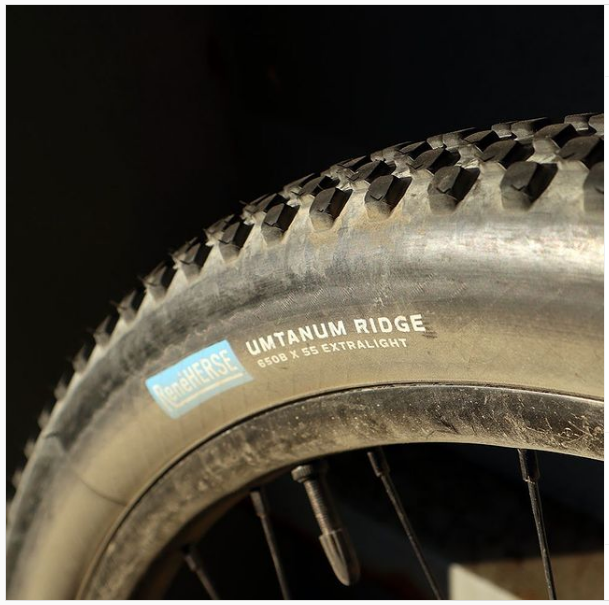
Heine suggests choosing your all-road bike by prioritizing certain aspects and components. First and foremost, he recommends focusing on the tires the frame can accommodate: this component is the only point of contact with the ground, in addition to providing minimal air suspension upon which comfort and performance depend. A 42mm diameter tire is now the standard (and a constantly increasing one) and allows for balanced handling. While sporting tradition has led us to believe that a narrower tire is faster, this bike demonstrates that this is simply not the case. On the contrary, Heine argues in favor of the largest possible air volume, which is more comfortable and therefore more efficient, and ultimately safer.
The riding position, linked to the frame size and geometry, is the second most important factor when choosing an all-road bike, according to Heine. Many manufacturers now offer a variety of all-road and gravel bike models with varying degrees of aggressive geometry, allowing for more precise handling with optimized aerodynamics on the one hand, and improved comfort and stability on the other, even when loaded with luggage. The bike's fork also plays a crucial role. In a variety of multi-surface riding situations, the fork's flexibility will positively impact performance, rider comfort, and even safety. This also contradicts the outdated and often misconception that a stiffer fork is preferable.
Heine finally examines the factors that should determine the choice between flat or drop handlebars (the latter offering a greater variety of riding positions and better aerodynamics), wheel size (smaller wheels being more responsive), and then the correct gear ratios for the drivetrain (easier ratios are preferable). The author interestingly points out that compatibility with peripheral equipment such as fenders, racks, or integrated bikepacking bags, as well as with a high-performance lighting system, is set to become increasingly important as our understanding of what an all-road bike should be capable of evolves throughout this revolution.
Even more surprising, Heine writes that he places little importance on the other mechanical components, most of which are easy to change. The majority of mechanical component groups, he writes, are now of very satisfactory quality. The same is true for the cockpit components: the specific size and curves of the handlebars, saddle, and pedals are highly customizable items that should be adapted to one's body type and needs as a priority, whatever the circumstances. Therefore, this is not a selection criterion that he considers very important. Along with the tires, these elements are subject to change, revolving, in a way, around the "platform" that is the frame of the all-road bike, the choice of which is truly critical depending on the needs and aspirations of the cyclist.
By: François R. Derbas Thibodeau

Livraison gratuite
Nous proposons la livraison en Amérique du Nord et la livraison gratuite au Canada pour les commandes supérieures à 149$.

Retours gratuits
Retours gratuits pendant 60 jours pour toutes les commandes.

Paiement sécurisé
transactions 100 % confidentielles et sécurisées.

